HMDs are professional instruments, not gadgets, eliminating blind spots in surgery, aviation, and high-risk training simulations.
ROCKVILLE , MD, UNITED STATES, May 7, 2026 /EINPresswire.com/ — The Facial Compute Revolution: HMDs Hit Overdrive
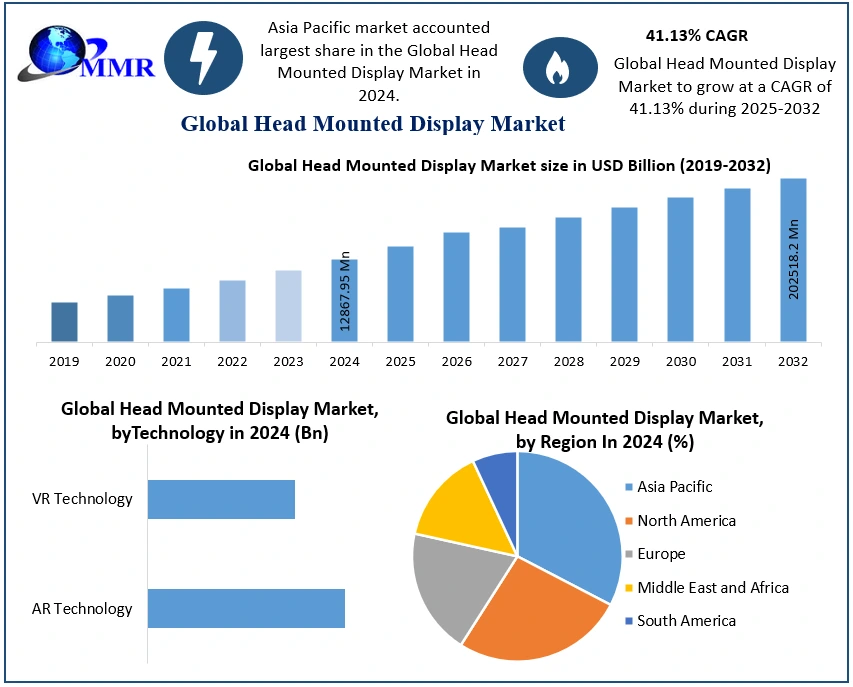
The screen has moved from the desk to the face. Valued at USD 12867.95 Million in 2024, the Head Mounted Display Market is racing toward USD 202518.2 Million by 2032 at a staggering 41.13% CAGR. This surge is fueled by surgeons using AR overlays, soldiers tracking targets through fog, and gamers in immersive worlds.
Get Full PDF Sample Copy of Report: (Including Full TOC, List of Tables & Figures, Chart) @ https://www.maximizemarketresearch.com/request-sample/28280/
As hardware crosses critical resolution and latency thresholds, HMDs are becoming functionally superior to fixed screens. Discrete HMDs dominate professional and military sectors with over 50% share, while integrated units lead consumer markets. With Asia-Pacific growing fastest and North America driving premium revenue, the HMD has evolved into a vital professional instrument.
What Is Driving the 41.13% CAGR in the Global Head Mounted Display Market?
Three forces drive HMD growth: enterprise AR reduces assembly errors by 40% through hands-free workflows; defense contracts, like the U.S. Army’s $21.9B IVAS, ensure high-value procurement; and medical AR provides real-time surgical overlays that outperform traditional training. Together, these sectors transform headsets into essential professional tools.
What Are the Barriers Limiting Faster Head Mounted Display Market Adoption?
The primary constraint is hardware ergonomics and form factor: current enterprise AR headsets including Microsoft HoloLens 2, Magic Leap 2, and Apple Vision Pro remain heavier and bulkier than sustained all-day professional use demands, limiting adoption in continuous-wear industrial contexts. Content and software ecosystem fragmentation across competing AR development platforms (ARKit, ARCore, MRTK) creates enterprise deployment complexity. Price accessibility remains a barrier in consumer segments below USD 500, where the mass-market gaming population is concentrated, limiting VR headset household penetration.
How Are Spatial Computing and AI Integration Creating the Head Mounted Display Market’s Highest-Value Growth Corridor?
The highest-conviction opportunity is spatial computing and AI-integrated HMDs. Sony Corporation and Siemens jointly launched NX Immersive Designer in 2025, integrating Sony’s XR HMD SRH-S1 with Siemens’ industrial design software to enable full-scale 3D product visualisation in physical space during the design review process. Early adopter data showed a 25% productivity boost in design review cycles versus screen-based CAD review, providing the first peer-reviewed enterprise ROI validation of spatial computing HMDs in industrial design at commercial scale. The second corridor is medical and surgical AR: Johns Hopkins Hospital’s AI-driven AR neurosurgery programme and orthopaedic procedure HMD support systems demonstrate that surgical AR is transitioning from research to clinical standard, creating a healthcare procurement wave that is the highest-CAGR application sub-segment in the global Head Mounted Display Market through 2032.
How Is the Global Head Mounted Display Market Structured by Type, Technology, and Application?
By type, discrete HMDs dominate at over 50% share due to high performance and customisation in professional and military use. Integrated HMDs hold 32% in consumer and enterprise standalone use. Slide-on HMDs are the fastest-growing type as the most cost-accessible entry point. By technology, VR leads driven by gaming and training, while AR is growing fastest due to enterprise hands-free overlay applications. By application, commercial leads by revenue; healthcare is the highest-CAGR sub-segment. By connectivity, wireless dominates for freedom of movement; wired retains share in high-bandwidth professional simulation requiring maximum fidelity.
By Type
Slide-on HMD
Integrated HMD
Discrete HMD
By Technology
AR Technology
VR Technology
Mixed Reality (MR)
By Component
Processors and Memory
Displays
Lenses
Sensors
Controllers
Cameras
Cases and Connectors
By Application
Commercial
Enterprise and Industry
Engineering and Design
Healthcare
Aerospace and Defense
Others
By Connectivity
Wired
Wireless
By Region
North America
Europe
Asia-Pacific
Middle East and Africa
South America
Get Full PDF Sample Copy of Report: (Including Full TOC, List of Tables & Figures, Chart) @ https://www.maximizemarketresearch.com/request-sample/28280/
Asia-Pacific Leads Head Mounted Display Market Growth; North America Commands Enterprise Premium Revenue
Asia-Pacific leads the global Head Mounted Display Market in growth velocity, driven by China’s gaming and enterprise AR hardware manufacturing density, Japan’s precision optics heritage supporting HMD component supply chains, South Korea’s consumer electronics adoption, and India’s rapidly expanding enterprise digitalisation programmes. China’s domestic AR/VR hardware market and ByteDance’s Pico VR headset platform have established Asia-Pacific as both the manufacturing and consumption growth engine through 2032.
North America anchors premium enterprise and defence revenue, underpinned by U.S. federal defence procurement contracts. Vision Products’ delivery of advanced AR head mounted displays to the U.S. Army in 2025, improving pilot situational awareness in rotorcraft operations, and Vuzix Corporation’s strategic aerospace and defence orders for lightweight waveguide-based AR displays confirm that defence procurement is sustaining a high-value enterprise HMD demand base in North America that is independent of consumer market cycles and generates long-term multi-year contract revenue for specialist HMD manufacturers.
Four Technology Transitions
AI Integration Makes HMDs Proactive Rather Than Passive Displays: Microsoft’s ongoing IVAS development for the U.S. Army integrates AI-powered threat detection, soldier biometric monitoring, and real-time battlefield mapping into a single HMD interface, establishing that the HMD’s next competitive evolution is not higher resolution but higher intelligence: displays that interpret the wearer’s environment rather than simply overlaying information on it.
Micro-OLED and Pancake Lens Technology Makes Enterprise HMDs All-Day Wearable: Apple Vision Pro’s micro-OLED display achieving 4K-per-eye resolution at 23 million pixels combined with Sony’s XR HMD SRH-S1 using pancake lens optics to achieve a form factor comparable to conventional safety glasses demonstrate that the weight and bulk barrier to all-day enterprise HMD wear is being resolved through optics miniaturisation, directly expanding the addressable industrial and medical application market.
Standalone Wireless HMDs Eliminate the Tethered PC Dependency: Meta Quest 3, Pico 4 Enterprise, and HTC Vive XR Elite’s standalone computing architectures have removed the PC tether that historically limited VR HMD deployment to fixed locations with dedicated computer hardware, enabling enterprise VR training to scale across distributed workforce locations without per-station GPU investment.
Spatial Computing Platforms Convert HMDs Into Enterprise Operating Systems: Apple’s visionOS, Microsoft’s Windows Mixed Reality, and Meta’s Horizon OS are establishing HMD-native operating system platforms that position head mounted displays not as peripherals to existing computing infrastructure but as primary computing interfaces in their own right, creating the application ecosystem depth that sustains long-term enterprise HMD adoption beyond initial novelty adoption cycles.
Market Key Players:
Meta Platforms Inc. / Oculus
Sony Corporation
Microsoft Corporation
Apple Inc.
Samsung Electronics Co. Ltd.
HTC Corporation
Magic Leap Inc.
Vuzix Corporation
ByteDance / Pico Technology
Google LLC
Lenovo Group Ltd.
Seiko Epson Corporation
LG Electronics Inc.
Huawei Technologies Co. Ltd.
Avegant Corporation
Get access to the full description of the report @ https://www.maximizemarketresearch.com/market-report/global-head-mounted-display-hmd-market/28280/
Key Recent Developments
2025: Sony and Siemens jointly launched NX Immersive Designer integrating Sony’s XR HMD SRH-S1 with Siemens NX industrial design software, enabling full-scale 3D spatial product visualisation during physical design review workflows, with early adopters reporting a 25% productivity improvement in design cycle time versus conventional screen-based CAD review processes.
2025: Vision Products delivered advanced AR head mounted displays to the U.S. Army specifically for rotorcraft operations, improving pilot situational awareness through real-time terrain and threat overlay systems, confirming that military HMD procurement at operational scale has moved beyond prototype validation into active deployment.
June 2024: Apple launched Vision Pro across major Asian markets including Japan, China, and Singapore at USD 3,499, marking the first expansion of spatial computing HMD hardware into Asia-Pacific consumer and enterprise markets and validating that premium HMD price points have found commercially sustainable demand outside North America.
January 2024: Sony Corporation announced a Spatial Content Creation System featuring its high-grade XR Head Mounted Display SRH-S1 with matched hand controllers, targeting professional 3D content creators and industrial design engineers requiring precise spatial interaction with digital objects at real-world scale.
FAQs:
Q1. What is the market size and revenue forecast to 2032?
Ans. Valued at $12.87B in 2024, the Head Mounted Display Market is projected to reach $202.52B by 2032 (41.13% CAGR). Growth is driven by defense contracts, enterprise training, surgical AR, and the rise of spatial computing platforms like Apple Vision Pro and Meta Quest.
Q2. What key tech advancements are driving 2026 growth?
Ans. Five pillars fuel this surge: 4K Micro-OLEDs, pancake optics (40% slimmer profiles), AI-enhanced threat detection, standalone processing, and native spatial OS ecosystems like visionOS and Horizon OS.
Q3. Which application segment has the highest CAGR?
Ans. Healthcare leads, shifting from research to clinical reality. Real-time surgical overlays and cost-efficient HMD simulations ($80 vs. $1,200 for cadavers) are revolutionizing anatomical training and neurosurgery workflows.
Analyst Perspective
Analysts at Maximize Market Research assess the Head Mounted Display Market’s 41.13% CAGR as the structural consequence of a technology that has crossed all three adoption thresholds simultaneously: performance threshold (micro-OLED, AI, sub-20ms latency), price threshold (standalone devices under USD 500 for consumer, under USD 3,500 for enterprise), and ecosystem threshold (visionOS, Horizon OS, Windows MR creating content depth that sustains use beyond initial adoption). The market’s transition from entertainment peripheral to professional mission-critical instrument is the inflection that makes the 41.13% CAGR structurally self-reinforcing: every enterprise ROI validation attracts adjacent sector adoption, every defence procurement contract de-risks commercial enterprise specification, and every surgical AR clinical proof point expands the healthcare addressable market without requiring new technology development. The USD 202.52 Billion destination by 2032 is the compounded arithmetic of these three thresholds resolving simultaneously.
Related Reports
Augmented Reality Market: https://www.maximizemarketresearch.com/market-report/global-augmented-reality-market/10038/
Augmented Reality Market by Component, Technology, Application, End User, and Region, Global Forecast to 2032
Virtual Reality Market: https://www.maximizemarketresearch.com/market-report/global-virtual-reality-market/6204/
Virtual Reality Market by Component, Technology, Application, End User, and Region, Global Forecast to 2032
Wearable Technology Market: https://www.maximizemarketresearch.com/market-report/global-wearable-technology-market/9027/
Wearable Technology Market by Product, Application, End User, and Region, Global Forecast to 2032
Spatial Computing Market: https://www.maximizemarketresearch.com/market-report/spatial-computing-market/226098/
Spatial Computing Market by Component, Technology, Application, End User, and Region, Global Forecast to 2032
Military Wearables Market: https://www.maximizemarketresearch.com/market-report/military-wearables-market/180567/
Military Wearables Market by Product, Technology, Application, End User, and Region, Global Forecast to 2032
Top Reports:
IP Multimedia Subsystem Market
About Maximize Market Research Pvt. Ltd.
Maximize Market Research is a premier global consulting firm headquartered in Pune, India. Serving clients across 45+ countries, MMR delivers high-granularity market intelligence across Information Technology, Healthcare, and Advanced Manufacturing, empowering enterprises with data-driven insights to make strategic decisions with confidence.
Domain Focus
This report falls under Maximize Market Research’s Electronics domain, spanning head mounted displays, augmented reality hardware, virtual reality systems, spatial computing platforms, and wearable enterprise technology across 45+ countries, delivering intelligence for technology investors, enterprise procurement teams, and immersive technology developers through 2032.
Lumawant Godage
MAXIMIZE MARKET RESEARCH PVT. LTD.
+91 96073 65656
akash.r@maximizemarketresearch.com
Visit us on social media:
LinkedIn
Instagram
Facebook
X
Legal Disclaimer:
EIN Presswire provides this news content “as is” without warranty of any kind. We do not accept any responsibility or liability
for the accuracy, content, images, videos, licenses, completeness, legality, or reliability of the information contained in this
article. If you have any complaints or copyright issues related to this article, kindly contact the author above.

Media gallery