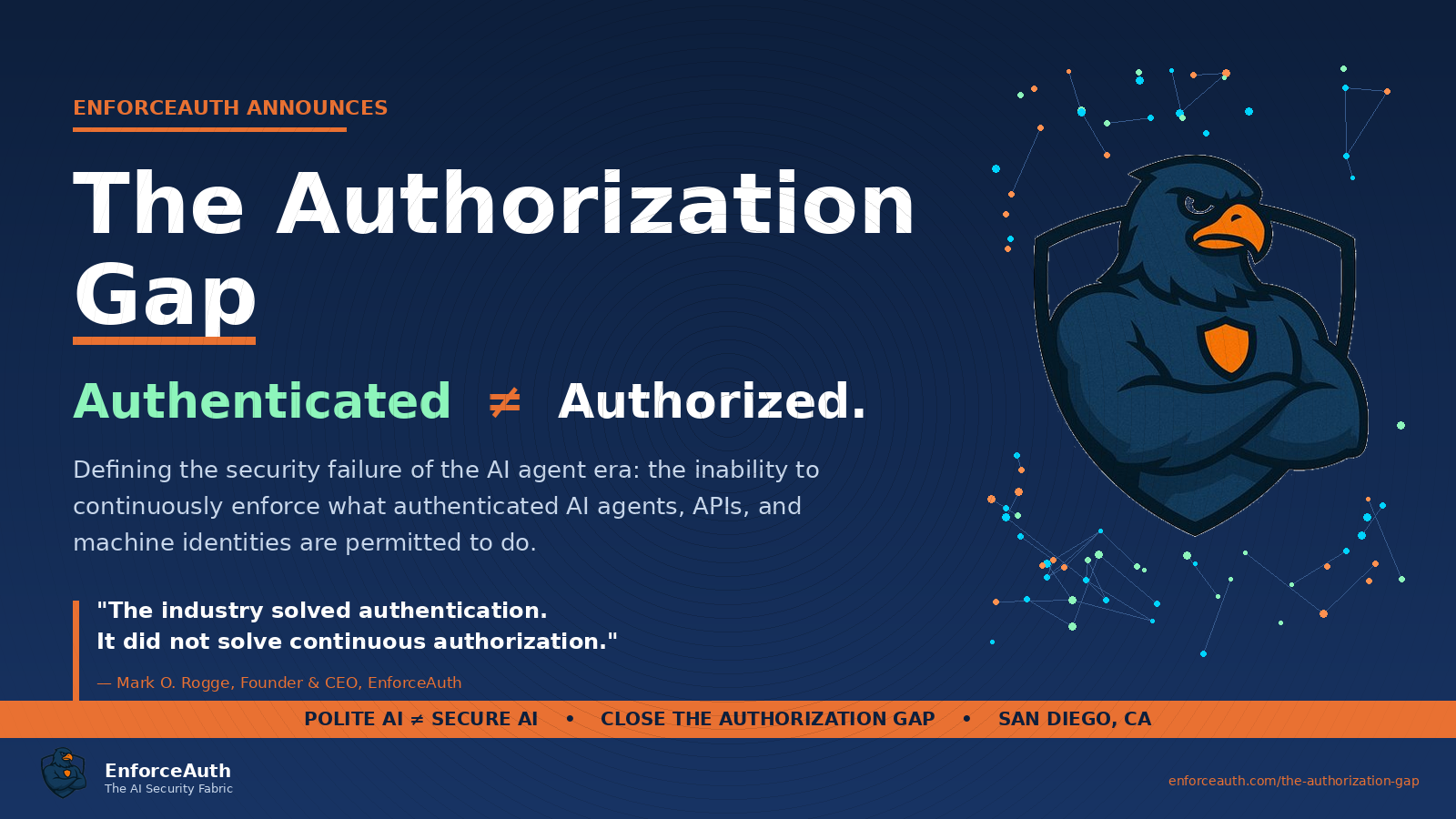
Authorization Gap Index & AUTHOR™ Maturity Model—the largest unaddressed attack surface in security: what authenticated AI agents are actually permitted to do.
SAN DIEGO, CA, UNITED STATES, May 21, 2026 /EINPresswire.com/ — EnforceAuth, the AI Security Fabric for runtime authorization, today launched The Authorization Gap
— a framework defining the security failure created when authenticated AI agents, APIs, and machine identities operate without continuous enforcement of what they are permitted to do. The launch includes an open Authorization Gap Index self-assessment and the AUTHOR™ Maturity Model, both available now at enforceauth.com/the-authorization-gap.
EnforceAuth is already deployed with a global Fortune 500 retailer as its first signed design partner and is engaged with a Tier-1 global bank preparing for DORA and the EU AI Act. The platform reached General Availability in February 2026 with a free tier of 1 million authorization decisions per month, no credit card required.
“The industry solved authentication. It did not solve continuous authorization,” said Mark O. Rogge, Founder and CEO of EnforceAuth. “Most enterprises can verify identity. Very few can continuously enforce what that identity is permitted to do across applications, infrastructure, data, APIs, and AI agents in real time. That gap is now one of the largest unaddressed attack surfaces in enterprise security.”
Why the Gap Exists Now
Traditional identity and access management was built for human users in predictable workflows — not autonomous AI systems invoking tools, calling APIs, orchestrating workflows, retrieving sensitive data, and initiating transactions at machine speed. In modern enterprises, non-human identities outnumber humans by an estimated 82 to 1 — and most operate without runtime policy.
“An authenticated AI agent can still delete data, exfiltrate records, or trigger financial actions if runtime authorization enforcement does not exist,” Rogge added. “Polite AI is not secure AI.”
Four Domains. One Continuous Policy Engine.
The Authorization Gap spans four enforcement domains organizations must secure simultaneously: Applications, Infrastructure, Data, and AI Workloads — agents, tools, MCP, and model APIs.
EnforceAuth closes the gap through the AUTHOR™ operating model: Assess (open-source discovery of embedded authorization logic), Govern (a central control plane for policy-as-code), Evaluate (runtime decisions for every action), and Defend (a forthcoming agentic firewall for human approvals and runtime intervention). The platform is built on Open Policy Agent (OPA) and Rego.
Open Tools Available Today
Authorization Gap Index — A free self-assessment that scores enterprise exposure across the four domains in under ten minutes.
AUTHOR™ Maturity Model — A five-stage roadmap for operationalizing continuous authorization governance.
Both are available now at enforceauth.com/the-authorization-gap.
“The next decade of cybersecurity will not be defined by who logged in,” Rogge concluded. “It will be defined by what systems were continuously authorized to do after authentication occurred.”
About EnforceAuth
EnforceAuth is the AI Security Fabric — a unified runtime authorization platform securing AI agents, machine identities, APIs, applications, infrastructure, and enterprise data through continuous policy enforcement. Built around policy-as-code and runtime decisioning, EnforceAuth closes the Authorization Gap across modern distributed environments. Learn more at enforceauth.com.
Media Contact
EnforceAuth Press Relations
info@enforceauth.com
www.enforceauth.com/the-authorization-gap
Mark Rogge
EnforceAuth
+1 612-868-7193
email us here
Visit us on social media:
LinkedIn
Legal Disclaimer:
EIN Presswire provides this news content “as is” without warranty of any kind. We do not accept any responsibility or liability
for the accuracy, content, images, videos, licenses, completeness, legality, or reliability of the information contained in this
article. If you have any complaints or copyright issues related to this article, kindly contact the author above.

Media gallery