SHANNON, CLARE, IRELAND, July 24, 2026 /EINPresswire.com/ — Announcing a new publication from Opto-Electronic Advances; DOI 10.29026/oea.2026.250299.
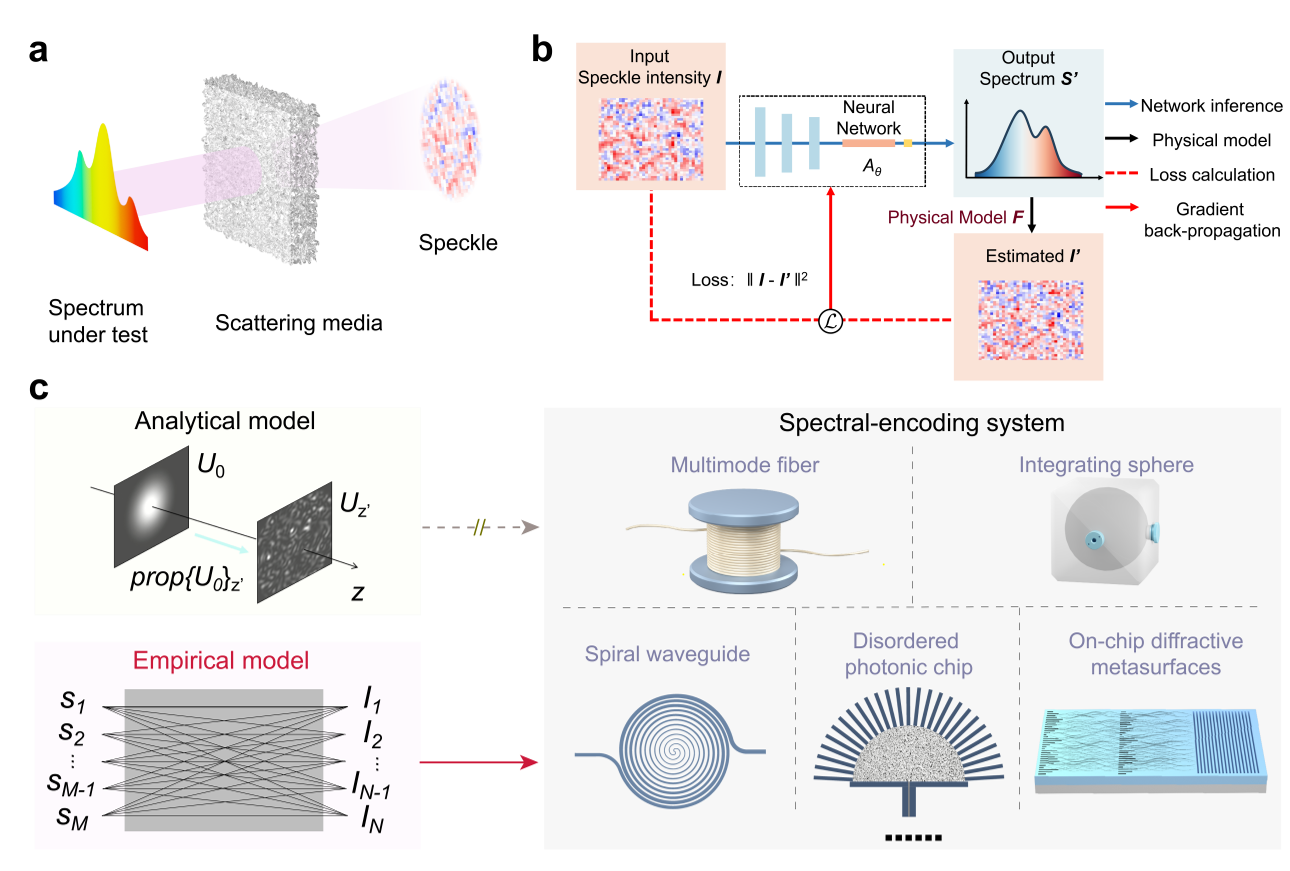
Spectrometers are fundamental instruments in modern industry and scientific research. However, traditional benchtop spectrometers suffer from high cost, heavy weight, and an inherent trade-off between resolution and system size. Speckle reconstructive spectrometer offers a promising solution by encoding spectral information into speckle patterns through disordered media and then decoding them via algorithms, paving the way for high-resolution and miniaturized devices (Fig. 1a). Existing decoding methods face two major bottlenecks: on one hand, physical-model-based regularization methods require prior knowledge of the target spectrum or make assumptions about its characteristics (e.g., sparsity, smoothness). On the other hand, deep learning techniques rely on massive “spectrum-speckle” paired datasets for training. Constructing diverse spectral datasets in practice is challenging, and neural networks trained on specific datasets often suffer from poor generalization, struggling to accurately reconstruct unseen spectral types.
To address these challenges, a research team from the College of Advanced Interdisciplinary Studies at the National University of Defense Technology has proposed a physics-aware neural network named PhyspeNet. This work is published in Opto-Electronic Advances under the title “PhyspeNet: An Empirical Physics-aware Network for Adaptive Speckle Reconstructive Spectrometry”
The core innovation of PhyspeNet lies in embedding the physical model describing the spectral encoding process as a differentiable module directly into the neural network. Unlike existing analytical model-driven neural networks in optics, the physical model embedded in PhyspeNet is an empirical spectral-spatial transmission matrix. This design effectively overcomes the modeling difficulties associated with representing random spectral encoding media using analytical theories (Fig. 1c). During the reconstruction process, the network starts from fixed random initial weights and iteratively optimizes for a single observed speckle pattern. The output spectrum is propagated through the empirical model, and the resulting speckle pattern should match the input. This physical consistency constraint guides the network to converge to the correct solution (Fig. 1b).
PhyspeNet offers three significant advantages. First, it requires no pre-training, fundamentally eliminating the dependence on large-scale spectral datasets. Second, it exhibits strong generalization capability. When testing on various synthesized spectral types, its average reconstruction error is 80% lower than that of traditional data-driven networks. Third, it provides adaptive regularization. By leveraging the inherent structural prior of convolutional neural networks, it avoids the accuracy degradation caused by the mismatch between pre-defined regularizers and spectral features.
The research team validate the hardware versatility of PhyspeNet on two spectral encoding platforms: an integrating sphere and a multimode fiber. The built speckle reconstructive spectrometer system achieves a spectral resolution of 2 pm and covers an operational range of 1000-1700 nm—the widest bandwidth reported for speckle reconstructive spectrometers to date (Fig. 2a-d). An amplified spontaneous emission light source with a full-width at half-maximum bandwidth of 40 nm is measured, demonstrating good agreement with measurements from a commercial spectrometer (Fig. 2e-f). Furthermore, the speckle reconstructive spectrometer integrated with PhyspeNet is deployed in a wavelength-division multiplexing data transmission experiment, successfully demodulating the original binary signals (Fig. 2g). Combined with fiber Bragg grating temperature sensing technology, the system achieves temperature measurement across a range of nearly 40 K (Fig. 2h-j). These experiments demonstrate the spectrometer’s potential for applications in optical communications and structural health monitoring.
Looking ahead, the integration of a low-cost external measurement unit to provide coarse spectral priors, working in synergy with PhyspeNet’s structural priors, promises to further enhance the accuracy and reliability of spectral reconstruction. This advancement would better meet the demands of scientific research involving the measurement of spectra with unknown shapes. Moreover, PhyspeNet holds promise for integration with polarization measurement and imaging techniques, facilitating high-dimensional light field image reconstruction for applications such as agriculture monitoring and remote sensing. Its inherent versatility also renders it suitable for miniaturized chip-scale platforms, paving new pathways for intelligent and portable spectral sensors.
Keywords: reconstructive spectrometer. Speckle, physics-aware neural network, empirical model
# # # # # #
# # # # # #
Opto-Electronic Advances (OEA) is a high-impact, open access, peer reviewed SCI journal with an impact factor of 22.4 (Journal Citation Reports 2024). OEA has been indexed in SCI, EI, DOAJ, Scopus, CA and ICI databases, and expanded its Editorial Board to 41 members from 17 countries.
# # # # # #
More information: http://www.oejournal.org/oea
Editorial Board: http://www.oejournal.org/oea/editorialboard/list
All issues available in the online archive (http://www.oejournal.org/oea/archive).
Submissions to OEA may be made using ScholarOne (https://mc03.manuscriptcentral.com/oea).
ISSN: 2096-4579
CN: 51-1781/TN
Contact Us: oea@ioe.ac.cn
Twitter: @OptoElectronAdv (https://twitter.com/OptoElectronAdv?lang=en)
WeChat: OE_Journal
# # # # # #
Liang JR, Jiang M, Li J et al. PhyspeNet: An empirical physics-aware network for adaptive speckle reconstructive spectrometry. Opto-Electron Adv, 250299 (2026). DOI: 10.29026/oea.2026.250299
Opto-Electronic Advances Editorial Office
Opto-Electronic Advances
+86 591 2286 1222
email us here
Legal Disclaimer:
EIN Presswire provides this news content “as is” without warranty of any kind. We do not accept any responsibility or liability
for the accuracy, content, images, videos, licenses, completeness, legality, or reliability of the information contained in this
article. If you have any complaints or copyright issues related to this article, kindly contact the author above.

Media gallery