
Foshan, Guangdong, China – October 23, 2026
Picking the best China resistance annealing Furnace isn’t just about price tags or the heating temps on the spec sheet. You’ve gotta match the furnace to your actual setup—your alloy, how much you’re producing, the size of the workpieces, and how you need it to cool. A furnace that works great for copper wire might struggle with stainless steel tubes. And honestly, the little stuff adds up. Chamber shape, insulation thickness, how the heating zones are laid out, atmosphere control—all of that can change the final hardness and surface finish.If you’ve been around the block a few times, you probably know the drill: before anyone starts haggling over price, it’s smart to look at how the equipment actually runs. So go ahead and ask for the temperature uniformity data, calibration records, heating-Element specs, and any tested production references. And a manufacturer you can trust? They should be able to walk you through exactly how theirannealing resistance furnace keeps temperature steady across the whole working chamber. You’ll also want it to cover stuff like loading methods, conveyor speed, gas protection, how to get in for maintenance, and emergency shutdown features. And definitely take a good look at the control cabinet. If the wiring labels are clear and the components are easy to replace, that can save you a lot of downtime down the road.Let’s be honest: no furnace is perfect. A cheaper model can look like a great deal at first — but give it a few months, and you might find it guzzles more energy or gives you uneven results. That’s exactly why a careful technical review matters. Don’t just trust the brochure. Look at real batch data. And ask the supplier about the stuff that actually keeps you running: installation help, operator training, spare parts, and service that responds when you need it. Also make sure the design checks off the workplace safety and electrical rules for your area. Also, don’t be afraid to push back on vague promises. A dependable China Resistance Annealing Furnace supplier? They’ll actually welcome practical, real-world questions and be upfront about their limitations. Honestly, that kind of honesty often tells you more than a slick sales pitch. And remember, the best choice isn’t always the most powerful furnace. It’s the system that gives you stable results, operating costs that make sense, and support you can count on for your specific process.
 Define the Purpose and Requirements of a Resistance Annealing Furnace
Choosing the best Resistance Annealing Furnace starts with its purpose, not its heating temperature. Define the material, wire diameter, batch size, production speed, and required hardness. Copper wire may need a different atmosphere and cooling rate than stainless steel strip. A target such as 650°C is incomplete without temperature uniformity. A 5°C variation can affect conductivity, grain structure, and rejection rates. The first specification is often wrong.
Energy demand also deserves attention. The U.S. Department of Energy’s Industrial Decarbonization Roadmap (2022) reports that process heating represents about 51% of energy use in U.S. manufacturing. Measure actual loading, idle time, heating speed, and furnace efficiency. Ask for recorded uniformity tests, not only catalog claims. The International Energy Agency’s Energy Efficiency 2023 report also identifies industrial heat as a major efficiency opportunity. These figures support a practical question: will the furnace save energy during real production?
Tips: Write a short process profile before requesting quotations. Include material dimensions, hourly output, atmosphere, maximum temperature, cooling method, control accuracy, and maintenance access. Check whether sensors remain stable after repeated cycles. I would also test one full production batch. Laboratory results can look excellent, but factory dust, open doors, and uneven loading may change performance. That reality matters.
Compare Furnace Types, Heating Methods, and Temperature Ranges
Choosing the best China resistance annealing furnace starts with the material, not the advertised power rating. Batch furnaces suit varied workloads and small lots. Continuous furnaces improve throughput for wire, strip, and repeated production. Chamber furnaces offer flexibility, while bell-type designs support larger coils and controlled cooling.Heating method matters. Electric resistance heating provides clean, adjustable heat and reliable temperature control. For copper, practical annealing often falls around 450–700°C. Aluminum commonly needs 300–450°C, while many steels require approximately 650–900°C. These ranges are guidance, not fixed recipes. ASM Handbook, Volume 4, stresses that alloy condition, holding time, and atmosphere change the final result. A simple temperature chart can mislead.Energy deserves equal attention. The International Energy Agency’s Energy Efficiency 2023 report identifies industry as responsible for about 37% of global final energy consumption. Insulation, automatic power control, and heat recovery can therefore influence operating cost significantly. Specify temperature uniformity, ramp rate, furnace loading, and atmosphere control. For sensitive copper surfaces, nitrogen or nitrogen-hydrogen mixtures may reduce oxidation, but safety systems must be independently verified. I would also request measured energy consumption per production batch, not only installed capacity. Marketing figures are neat. Real loads are not. A furnace that reaches 1,000°C may still perform poorly at 550°C under uneven loading.
Evaluate Chamber Size, Material Compatibility, and Production Capacity
Choosing the best China resistance annealing furnace starts with the chamber, not the advertised heating temperature. Measure your largest workpiece, fixture, and loading clearance. Leave room for airflow and thermal expansion. A chamber that barely fits today may limit production next year. In my experience, an extra 100 millimeters of working width can prevent awkward loading and damaged insulation.Material compatibility needs careful checking. Stainless steel, copper alloys, and nickel-based parts may require different atmospheres and temperature profiles. Ask whether the chamber lining, heating elements, and trays tolerate your process temperature. Also confirm resistance to oxidation, scale, and cleaning chemicals. A suitable electic resistance furnace should maintain stable heat across the load, not only near the sensors. Request temperature uniformity data from several chamber zones.Production capacity is more than chamber volume. Compare batch weight, heating time, cooling time, and daily cycle targets. A 300-kilogram furnace may appear efficient, yet slow cooling can create a serious bottleneck. Check controller repeatability and data-recording functions. These records support process audits and help identify drift before defects increase. Capacity estimates can be optimistic. I would test them with your actual fixtures and loading pattern. That step may expose an uncomfortable limitation before installation.
How to Choose the Best China Resistance Annealing Furnace?
Evaluate chamber size, material compatibility, and production capacity before selecting a resistance annealing furnace configuration.
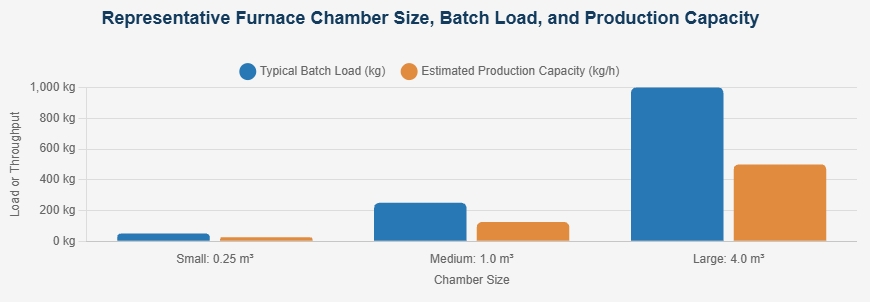
Small Chamber
About 0.25 m³, suitable for laboratory work, small batches, and copper or aluminum alloy components.
Medium Chamber
About 1.0 m³, suitable for regular production of stainless steel, nickel alloy, copper, and aluminum parts.
Large Chamber
About 4.0 m³, suitable for heavy loads and continuous production, provided uniform temperature control is maintained.
The chart uses representative engineering values based on a two-hour thermal cycle. Actual capacity depends on alloy type, loading density, heating rate, holding time, cooling method, and atmosphere control. Vacuum or inert-gas operation is generally preferred for oxidation-sensitive materials.
Check Temperature Control, Uniformity, and Atmosphere Protection
Choosing a China resistance annealing furnace starts with temperature control, not the catalog price. Ask for the working range, control accuracy, and recorded heating curves. A stable controller should limit overshoot when the chamber reaches the setpoint. Small errors matter. A steel coil may discolor or soften unevenly after repeated cycles. During inspection, compare the display with an independent calibrated thermocouple. Do not rely on the screen alone. My own mistake was accepting a digital reading without checking sensor location. That shortcut later complicated process adjustments. An Electric Resistance Furnace needs measured performance, not attractive specifications.
Uniformity requires a practical test. Load the chamber as your production team will. Then map temperatures near corners, doors, and the center. Empty-chamber data can look excellent but mislead operators. Ask for results at the actual annealing temperature and load. Record stabilization time, not only the peak value. A difference of several degrees may suit one alloy and harm another. Get written tolerances. I have seen buyers focus on maximum temperature while ignoring cold spots near the door. That choice can increase rework.
Atmosphere protection controls surface quality. Check door seals, gas-flow stability, exhaust design, and oxygen monitoring. Nitrogen or another approved protective gas should enter evenly. Watch for leaks and turbulent dead zones. Request leak-test records and alarm settings. The furnace should respond safely when gas pressure drops. Test that function before acceptance. Some specifications sound convincing, but evidence matters more. Leave room for maintenance access; blocked sensors are easy to overlook. Review spare thermocouples, calibration intervals, and operator training. No furnace is perfect. The uncomfortable details often deserve the closest inspection.
Assess Energy Efficiency, Safety Features, and Maintenance Needs
How to Choose the Best China Resistance Annealing Furnace?
An Aluminum Brazing Resistance Furnace should be judged by measured output, not brochure temperature. The IEA’s Energy Efficiency 2023 report states that industry consumed about 37% of global final energy in 2022. Therefore, compare energy use per kilogram of processed material. Request data for heating, holding, cooling, and standby modes. Check insulation thickness, door-seal quality, automatic power control, and temperature uniformity. Small losses matter. A stable heating profile can reduce rework, even when the initial purchase price is higher.
Safety deserves equal attention. Look for over-temperature protection, guarded electrical cabinets, emergency stops, and door interlocks. Confirm that exhaust systems control heat and process fumes effectively. NFPA 86 provides widely used guidance for industrial ovens and furnaces, including safety controls and installation practices. Ask for documented test results, not general assurances. Operators should also receive practical training for loading, unloading, and fault response.
Maintenance needs are often underestimated. The U.S. Department of Energy’s Operations & Maintenance Best Practices guide reports that predictive maintenance can reduce maintenance costs by 25–30% and decrease downtime by 35–45%. Select a furnace with accessible heating elements, replaceable thermocouples, clear alarm records, and simple calibration procedures. Keep spare sensors available. I would still question optimistic maintenance intervals; dust, cycling frequency, and loading habits change real results. A quarterly inspection may be sensible, but actual service data should decide.
Compare Suppliers, Customization Options, Warranty, and Total CostHow to Choose the Best China Resistance Annealing Furnace?
Supplier comparison should begin with evidence, not glossy photographs. Request temperature-uniformity charts, power-consumption records, calibration certificates, and references from similar production lines.
The U.S. Department of Energy’s Industrial Decarbonization Roadmap reports that process heating uses about 60% of manufacturing energy. Therefore, a furnace with stable insulation and accurate controls can influence operating costs for years.
Ask suppliers to state heating power, usable chamber volume, cycle time, and expected energy consumption under your actual load.
Customization often determines whether the furnace works smoothly. Check chamber dimensions, conveyor or batch loading, cooling arrangements, protective atmosphere, controller functions, data logging, and alarm settings.
A 30 kW furnace operating eight hours daily for 250 days consumes about 60,000 kWh annually.
Small efficiency differences become visible on the electricity bill. I would not accept “energy saving” without test conditions. That claim needs numbers.
Warranty terms deserve the same attention as the heating elements. Confirm coverage periods, excluded parts, remote support, response times, spare-part availability, and commissioning responsibility.
ISO 9001 certification can support process consistency, but it does not guarantee furnace performance. The total cost should include installation, ventilation, calibration, maintenance, downtime, energy, and operator training.
A cheaper quote may become expensive after one failed thermocouple or delayed replacement part. Look beyond price.
My practical warning is simple: supplier promises can sound precise, while real production loads remain unpredictable. Require a factory acceptance test and written performance limits before payment.
Conclusion
Choosing the best Resistance Annealing Furnace begins with clearly defining your production purpose, material requirements, workpiece dimensions, target temperature, and expected output. Different furnace structures and heating methods offer varying temperature ranges, heating speeds, chamber capacities, and operating flexibility. It is important to confirm that the chamber size, lining materials, and internal components are compatible with the materials being processed and suitable for both current and future production needs.A reliable furnace should provide accurate temperature control, stable heating uniformity, and effective atmosphere protection when oxidation or contamination must be minimized. Energy efficiency, safety systems, ease of maintenance, and access to replacement parts also influence long-term performance and operating costs. When comparing suppliers, consider their engineering capabilities, customization options, delivery support, warranty terms, and after-sales service. The best decision should be based not only on the purchase price, but also on total cost, productivity, durability, safety, and the furnace’s ability to meet your specific manufacturing goals.
About Us
Foshan Huichengsheng Machinery Equipment Co., Ltd. It was established in 2015. It has a strong sales ability and an attentive after-sales service team. In 2018, it reached a strategic cooperation with Foshan Fengyuan Heat Treatment Electric Furnace Factory in Chancheng District, and jointly established a subsidiary ( Foshan Huichengsheng Furnace Co., Ltd.).
Media Contact
Company Name: Foshan Huichengsheng Furnace Industry Co., Ltd.
Contact Person: Media Relations
Email: Send Email
Country: China
Website: https://www.fshcsfurnace.com/
Press Release Distributed by ABNewswire.com
To view the original version on ABNewswire visit: Comprehensive Guide Details Critical Considerations for Purchasing High-Performance China Resistance Annealing Furnaces
Media gallery



